A retirement portfolio target can be estimated by dividing the annual spending that is not covered by dependable income by an assumed initial withdrawal rate. The formula is simple. Estimating spending, income, inflation, taxes and a suitable withdrawal rate is not.
A useful target therefore shows its assumptions instead of presenting one universal number. It should also distinguish today’s purchasing power from the larger nominal amount that may be required decades from now.
Build your own estimate: the Retirement Savings Calculator inflates spending and other income to retirement, calculates a portfolio target and compares it with projected savings.
The basic retirement target formula
Start with expected annual retirement spending and subtract dependable annual income that does not need to come from the investment portfolio:
Annual portfolio income gap = retirement spending − pension and other dependable income
Then divide the positive gap by an initial withdrawal rate:
Portfolio target = annual portfolio income gap ÷ withdrawal rate
If annual spending is €36,000, dependable income is €12,000 and the assumed withdrawal rate is 4%, the gap is €24,000 and the target is €600,000 in the same purchasing-power terms.
| Annual spending | Other annual income | Portfolio income gap | Target at 4% | Target at 3% |
|---|---|---|---|---|
| €24,000 | €12,000 | €12,000 | €300,000 | €400,000 |
| €36,000 | €12,000 | €24,000 | €600,000 | €800,000 |
| €48,000 | €12,000 | €36,000 | €900,000 | €1,200,000 |
| €60,000 | €18,000 | €42,000 | €1,050,000 | €1,400,000 |
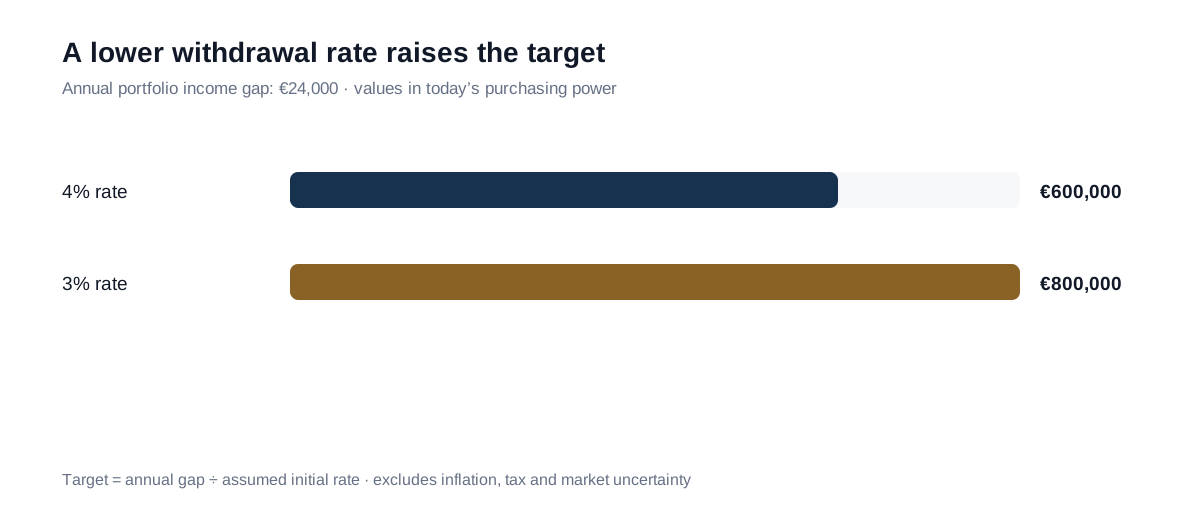
The matrix does not recommend 3% or 4%. It shows how strongly the target changes when the withdrawal-rate assumption changes.
Estimate retirement spending before the portfolio
Current spending is a starting point, not an automatic retirement budget. Some work-related costs may fall. Healthcare, support for family, travel or home maintenance may rise. Housing costs depend on whether rent or debt continues.
Separate spending into three groups:
- Core spending: housing, food, utilities, insurance, transport and healthcare.
- Flexible spending: travel, leisure, gifts and optional purchases.
- Irregular spending: repairs, vehicle replacement, home improvements and other costs that do not appear every month.
The Monthly Expenses Calculator can convert weekly, quarterly and annual costs into comparable monthly amounts. A retirement estimate that omits irregular costs can look precise while materially understating the target.
Count other income carefully
Pensions, public retirement benefits, annuity payments, rent and part-time work can reduce the amount the portfolio must provide. The timing and reliability of each source matters.
An income source that begins several years after retirement does not cover the earlier gap. Variable rent is not equivalent to a guaranteed pension. Gross income may not equal spendable income after tax, fees, vacancies or maintenance.
Country-specific public benefits and pensions should be estimated from the relevant official provider. A global calculator cannot infer eligibility, claiming rules, tax treatment or future policy.
Convert today’s target into a future amount
If the estimate is expressed in today’s money, inflation must be reflected when comparing it with a future nominal portfolio. The future amount of a current target is:
Future target = target today × (1 + inflation)years
At 2.5% annual inflation, €600,000 in today’s purchasing power becomes approximately €1.26 million after 30 years. That larger nominal number does not represent twice the real lifestyle. It reflects lower future purchasing power per euro.
Project savings using explicit assumptions
A deterministic projection compounds current savings and future contributions at a fixed assumed return. It can answer whether the chosen assumptions reconcile. It cannot show the probability of reaching the target.
Investment returns arrive unevenly. Fees and taxes reduce what remains. Contributions may change with income, unemployment or household responsibilities. A single return assumption should be tested alongside weaker scenarios rather than treated as a forecast.
Why the withdrawal rate changes the answer
The withdrawal rate connects the portfolio to first-year spending. A 4% rate is equivalent to multiplying the portfolio-funded income gap by 25. A 3% rate multiplies it by about 33.3.
A lower rate produces a larger starting target because less is withdrawn from each unit of portfolio. That does not make the outcome guaranteed. Withdrawal research depends on investment mix, market history, retirement length, inflation adjustments and spending flexibility.
The 4% Rule for Retirement Withdrawals explains the historical research and the limits of turning it into a universal rule.
A practical estimation process
- Estimate annual retirement spending in today’s money.
- Include irregular costs and a realistic treatment of healthcare and housing.
- Estimate dependable income from official or contract sources.
- Calculate the portfolio-funded income gap.
- Choose and disclose a withdrawal-rate assumption.
- Calculate the target in today’s money.
- Inflate the target to the planned retirement date when comparing nominal balances.
- Project current savings and contributions using several return assumptions.
- Review taxes, fees, longevity, beneficiaries and country-specific rules separately.
Methodology and limitations
The formulas, matrix and worked examples are original Finance Charts analysis. They are deterministic and do not model a distribution of market returns, sequence risk, lifespan, taxes, fees, contribution limits, account access rules or changes in spending.
Investor.gov demonstrates compound-interest calculations. The US Department of Labor’s retirement guides discuss inflation, compounding and investment risk. The US Consumer Financial Protection Bureau also emphasizes the importance of pension and public-benefit decisions in retirement planning.
- Investor.gov — Compound Interest Calculator
- US Department of Labor — Savings Fitness
- Consumer Financial Protection Bureau — Planning for retirement
- Finance Charts — Methodology
Important: This guide is educational. It does not estimate a suitable retirement age, withdrawal strategy, investment allocation, pension election or target for a particular person.