The debt snowball directs extra payments to the smallest balance first. The debt avalanche directs them to the highest interest rate first. If every other assumption stays the same, highest-interest-first generally minimizes interest. Smallest-balance-first may close an account earlier and provide a more visible milestone.
The choice is not only a slogan. A valid comparison must hold the monthly payment constant, continue required minimums on every debt and roll freed payments to the next target.
Compare your balances: the Debt Payoff Calculator models both orders with the same balances, APRs, minimums and extra payment.
How the debt snowball works
- List each balance and required minimum payment.
- Pay every required minimum.
- Direct the remaining payment budget to the smallest current balance.
- When that debt reaches zero, roll its payment into the next-smallest balance.
- Continue until all modeled balances reach zero.
The method prioritizes an early completed balance. It does not use APR as the primary ordering rule, although APR can break a tie between equal balances.
How the highest-interest method works
- List each balance, APR and required minimum payment.
- Pay every required minimum.
- Direct the remaining payment budget to the debt with the highest APR.
- When that debt reaches zero, roll its payment into the next-highest APR.
- Continue until all modeled balances reach zero.
This order attacks the most expensive rate first. Under the same fixed-rate assumptions and payment budget, that normally reduces total modeled interest.
| Feature | Debt snowball | Highest-interest first |
|---|---|---|
| First target | Smallest balance | Highest APR |
| Primary advantage | Earlier account payoff may be visible | Generally lower modeled interest |
| Required payments | Continue on every debt | Continue on every debt |
| Freed payment | Rolls to next-smallest balance | Rolls to next-highest APR |
| Information required | Balances and minimums; APR still affects the result | Balances, minimums and APRs |
| What it cannot determine | Affordability, creditor rules, legal options or the best action for a specific person | |
A simplified worked example
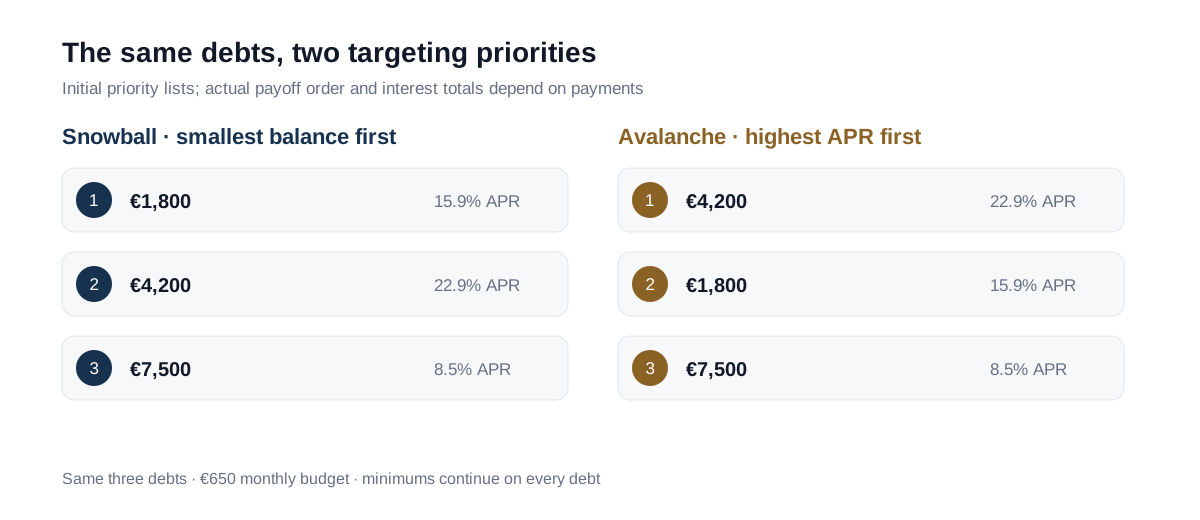
Suppose three debts have balances of €1,800 at 15.9%, €4,200 at 22.9% and €7,500 at 8.5%. Required minimums total €400, and the borrower can add €250 per month, creating a fixed €650 payment budget.
The snowball targets the €1,800 balance first because it is smallest. The highest-interest method targets the €4,200 balance first because its 22.9% APR is highest. Both methods continue the minimums on the other two debts.
The exact difference depends on how interest accrues, when payments post and how lenders allocate payments. A monthly calculator is therefore an estimate, not a statement payoff quote. The direction of the tradeoff is still informative: sending the same extra amount to the higher rate prevents more interest from accumulating during that period.
Why minimum payments matter
A comparison that ignores minimum payments can be misleading. Minimums reduce balances outside the target order, change over time under some contracts and may be calculated as a percentage rather than a fixed amount.
When monthly payments are too small relative to interest, repayment can take much longer or remain out of reach within the modeled period. The Finance Charts calculator simulates each month, including minimum payments and freed payment capacity, for up to 1,200 months. It reports no payoff within the model if balances remain at that limit. A single month of rising total debt does not by itself prove that the plan cannot reach payoff.
Costs the simple model leaves out
- Daily interest: many accounts accrue interest daily rather than once per month.
- Variable rates: an APR can change during the payoff period.
- Fees: late fees, annual fees and penalty charges change the balance.
- New transactions: additional borrowing can delay or prevent payoff.
- Payment allocation: a creditor may apply payments according to contract or law.
- Promotional terms: deferred-interest or introductory-rate balances can require different analysis.
Questions to check before choosing an order
- Can every required minimum be paid on time?
- Is any account already delinquent or subject to urgent legal or collateral risk?
- Are rates fixed, variable or promotional?
- Is there a small cash buffer for unavoidable shocks?
- Will the extra payment remain realistic in lower-income or higher-expense months?
- Does the creditor permit early repayment without a penalty?
An account with legal, housing, utility, tax or secured-asset consequences may deserve attention that a pure balance-or-APR ordering rule does not capture. Contact the creditor or an appropriate qualified adviser when the situation involves delinquency, collection, insolvency or legal risk.
Methodology and limitations
The comparison table and example are original Finance Charts analysis. The calculator uses monthly interest equal to current balance × APR ÷ 12, fixed APRs, fixed entered minimums and a constant total payment budget. It pays required minimums first and rolls unused payment capacity to the current target.
The US Consumer Financial Protection Bureau describes both the smallest-debt-first method and the highest-interest-rate method, including their motivation and cost tradeoffs.
- Consumer Financial Protection Bureau — How to reduce your debt
- Consumer Financial Protection Bureau — Your Money, Your Goals toolkit
- Finance Charts — Methodology
- Finance Charts — Emergency Fund Calculator
Important: This guide is educational. It does not recommend borrowing, refinancing, settlement, consolidation, insolvency or a repayment strategy for a particular person.